Start with your local collection
The right sorting arrangement depends on the municipality and sometimes the type of home. Check current information from your council or collection service before buying permanently labelled compartments. A colour in a product photograph is not a national sorting instruction. Even the grouping of plastics, metal packaging and drinks cartons can vary locally.
Write down which streams you separate indoors and where they eventually go. Consider paper, packaging, residual waste and perhaps food scraps, but create compartments only for streams relevant to your collection. Glass or bulky packaging might be stored elsewhere so the kitchen does not have to accommodate everything.
Let an ordinary week set the proportions
Watch what fills up over several days. One small household may produce much cardboard and little residual waste, while another mainly collects food scraps. Three equal compartments look orderly but may not match those proportions. Separate containers or adjustable dividers offer more freedom than a fixed arrangement.
Include the emptying schedule. A large food-waste compartment is not an advantage if it encourages leaving the contents too long. A small removable container can be easier to empty and clean frequently. Usable capacity also depends on the liner: a poor fit wastes space or slips from the rim.
Allow for movement around the bin
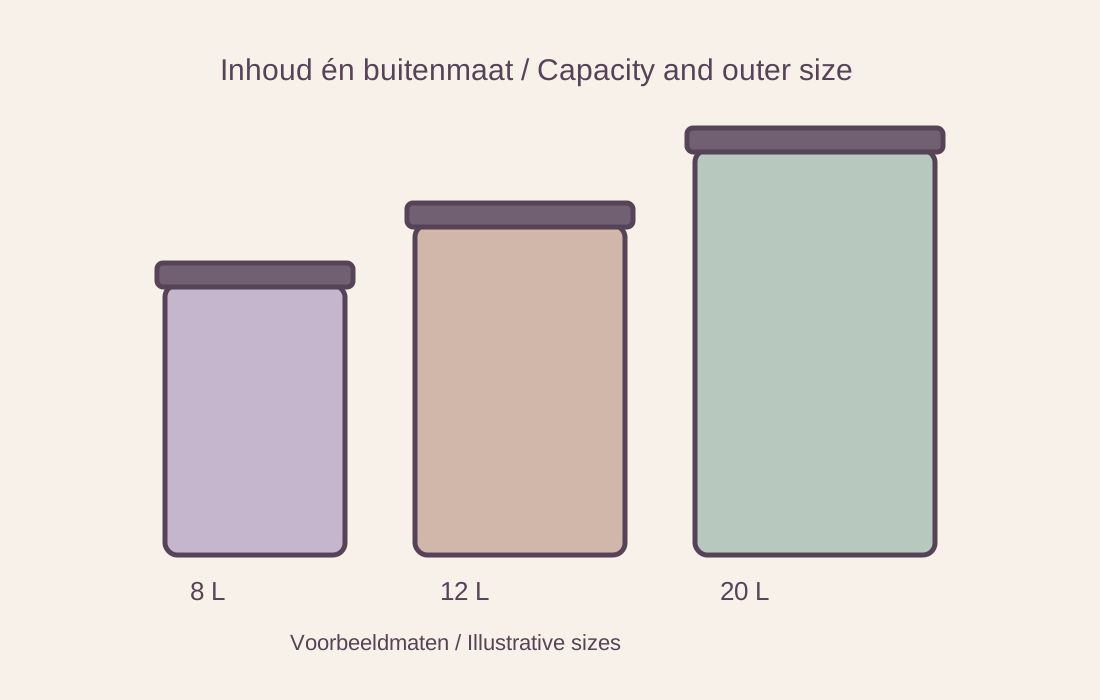
Measure more than the closed outside dimensions. A pedal needs room for your foot, a lid must rise and a pull-out system needs a clear path. Beneath a worktop, an opening lid may strike the underside. Cabinet hinges can reduce the usable width for a sliding bin.
Imagine removing a full inner bucket. Can you lift it vertically, or must the entire bin be moved first? Its handle should remain reachable with a liner folded over the edge. A system that moves smoothly when empty may feel different when loaded. Read the installation and load information before choosing a cupboard mechanism.
Make the arrangement understandable
Simple replaceable labels help when several people use the same bins. Use the terminology in local collection guidance. Avoid inventing rules based only on the appearance of packaging. An incorrectly sorted item is not corrected by being neatly placed in a coloured compartment.
Put the most frequently used opening within easiest reach. An open compartment may suffice for paper, while a lid may be preferable elsewhere. Check whether surfaces and corners are accessible for cleaning. Electronic sensor lids add batteries and controls; some households will find a mechanical opening simpler to live with.
Leave a plan for exceptions
Batteries, lamps and small electrical devices do not automatically belong in ordinary kitchen waste streams. Store them temporarily according to applicable safety instructions and take them to a suitable collection point. For small devices in the Netherlands, Wecycle provides collection information. Check the chosen location's acceptance rules before travelling.
After a week, notice which compartment is continually too small and which remains partly empty. Moving a divider or collecting paper elsewhere may be enough. A successful arrangement is one people understand, can reach and can empty regularly, rather than necessarily the bin with the greatest number of separate compartments.