Read two numbers separately
Maximum capacity tells you how much the scale can carry, including the bowl. The displayed increment tells you the size of the steps between readings. Neither number alone proves accuracy. A scale that displays whole grams is not automatically suitable for measuring a very small quantity just because its maximum load is generous.
List the amounts you regularly weigh. Flour for a loaf, a bowl of vegetables and a tiny portion of yeast are different tasks. If very small quantities matter to your recipes, look for a manufacturer-stated minimum load and accuracy information around that range. You may need a separate small-quantity scale rather than expecting one kitchen model to cover everything.
Bring the bowl into the decision
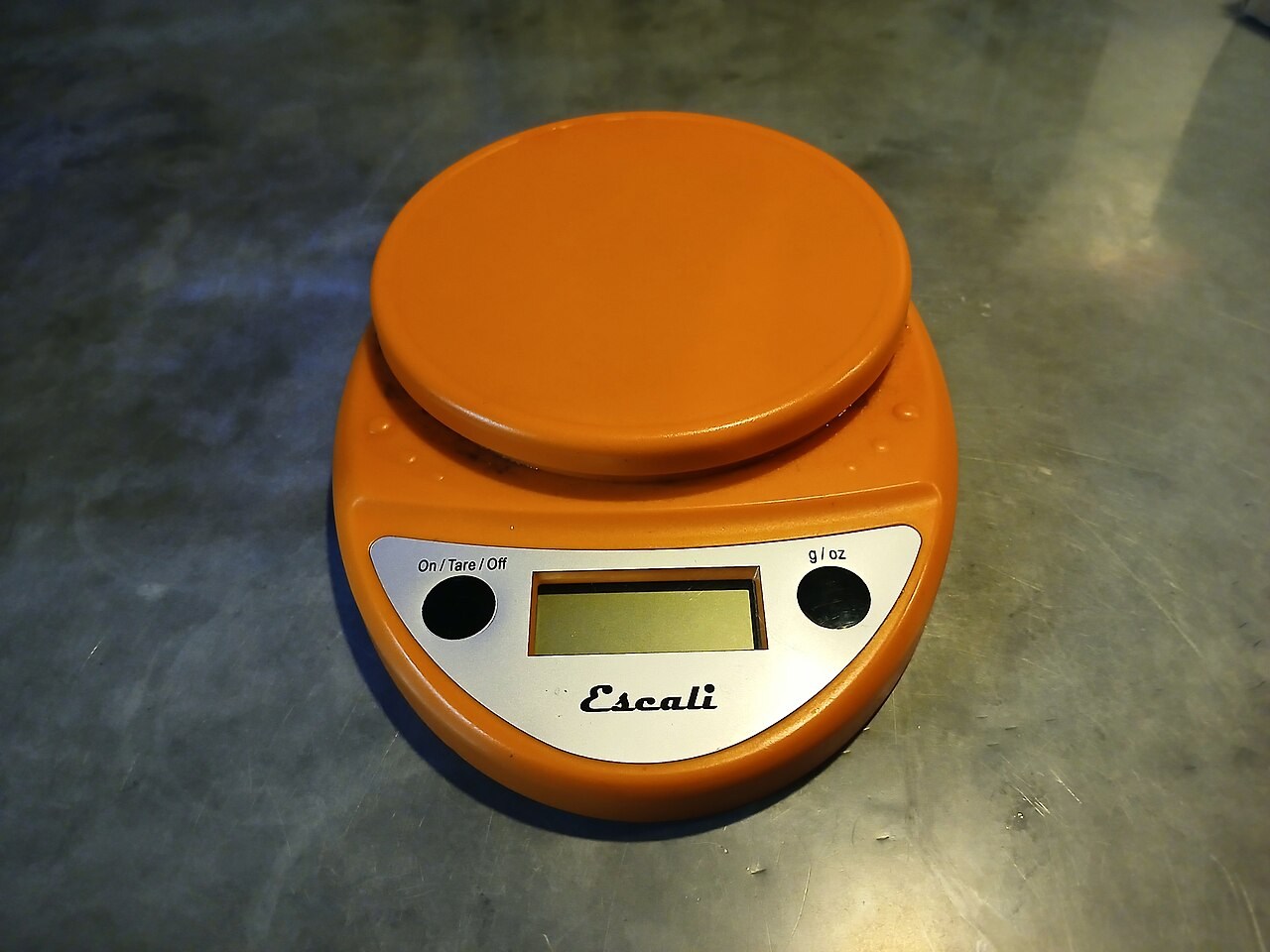
Place a bowl on the platform in a shop if permitted, or compare its base diameter with the product dimensions. A wide bowl can hide the screen even when the scale supports its weight. An angled or projecting display can help, but the useful test is whether you can read it with your own mixing bowl in place.
Tare lets you subtract the container's displayed weight, but it does not increase the physical load limit. A heavy glass bowl consumes some of the available capacity. When adding ingredients in stages, account for the total load that will eventually sit on the platform. Do not consider each ingredient in isolation.
Controls during a recipe
Check how the scale changes units and returns to zero. A sensitive touch panel may be easy to wipe, yet awkward when your hands are damp or dusted with flour. Physical buttons have their own cleaning details. Look for a layout that separates unit selection from the control you will press repeatedly.
Automatic shut-off can interrupt a slow recipe. Read whether the timer is adjustable and whether the current reading is retained. If the scale switches off halfway through adding ingredients, you should not have to guess the amount already in the bowl. For recipes with pauses, this feature can matter more than an extra unit mode.
Where it will live
Compare battery availability or charging arrangements and check whether the scale can stand upright for storage. Keep it on a firm, level surface for use and follow instructions about cleaning around the display and battery compartment. A removable platform can simplify washing, but the electronics still need the treatment specified by the maker.
Choose the scale around the least forgiving task in your routine. A large capacity is useful for heavy bowls; clear low-end specifications are useful for small ingredients. If a listing gives only a headline capacity and no information about the amounts you actually need, ask before buying rather than interpreting extra decimal places as proof.